The New Northern Kentucky Islamic Center

As recently reported in the Cincinnati Enquirer, Northern Kentucky will soon be home to its first mosque. Here are some brief thoughts:

Freedom of religion applies to all Americans of all religions. I have often heard Christians thank God for the freedom to worship in the United States. Like freedom of speech, freedom of religion doesn’t apply only to popular, inoffensive ideas. In parts of the US, evangelical Christianity is viewed as offensive and dangerous. Should those regions be allowed to ban new church buildings?

Few Muslim countries allow freedom of religion. We should shame them by our example. Yes, it is indeed unfair that Muslims are allowed to build mosques in the US, while Christians are not allowed to build churches in Saudi Arabia, even though more than one million Catholic Filipinos live and work in Saudi Arabia. In fact, the laws of Saudi Arabia (and many other Muslim nations) directly contradict the United Nations Universal Declaration of Human Rights – which is binding on Saudi Arabia as a UN member[*]. What would we gain by lowering ourselves to the hypocrisy of Saudi Arabia?

The Gospel spreads through relationships and truth, not government enforcement. In Rodney Stark’s book Cities of God: The Real Story of How Christianity Became an Urban Movement and Conquered Rome, the Baylor historian and sociologist demonstrates that the early church grew from 150 Jesus followers to more than 30 million through ordinary relationships: family members, coworkers, neighbors. Elsewhere, Stark has suggested that gaining its status as the state religion of the Roman Empire actually slowed the growth of Christianity. If we want to share the love of Christ with Muslims, we can do so only by building relationships with them, not by isolating them from our community.

Muslims already live in Northern Kentucky. This mosque would not be built if there were not already a community of Muslims in Northern Kentucky. By opposing the mosque, I’m not sure what we gain other than antagonizing our neighbors. Opponents of the mosque cite fears of terrorism. But is there a faster way to turn a Muslim youth against the US than by making him feel hated and unwanted?

What should we do then?

  • Welcome our Muslim neighbors as fellow Americans and support their freedoms under the US Constitution.
  • Build friendships with our Muslim neighbors so that they can witness Christian love and hospitality firsthand.
  • Share the gospel with them in word and deed, in the hope that they will accept the good news of Jesus Christ.

Today, a major problem in Muslim countries is the perception that Christians are uncaring, immoral, and hypocritical. We may not be able to do much to shape the views of Muslims overseas, but shouldn’t we ensure that American Muslims see a better side of Christianity?


[*]Tellingly, the Saudis abstained from the original adoption.

World Religions: Christianity

We had a great turnout last night.  If you missed the first class, feel free to drop in another time.  We’ll be meeting Wednesday nights at 6:30pm at Lakeside Christian Church. There are a couple of nights that I will be out of town, so we won’t be having class on March 24, April 28, or May 5. Missing class for two weeks in a row is not ideal, I know, but a last minute change of schedule came up just as we were starting class. On May 5, I’ll be in Chicago auditioning for Jeopardy!

Each week, I’ll post some additional resources online, as well as the notes and slides from the class. For Christianity, here are a few good resources:

  • GetReligion.org follows media coverage of all religions. It’s a great place to see critical assessments of how well the media covers various religions, as well as to learn a lot more about different religions.
  • Christianity Today’s news page collects Christianity-related news from across the Internet. CT also has a Christian History page that collects articles about Christian history, as well as important events. By utter coincidence, today is the day when Alexander Campbell, one of the founders of the Restoration Movement, died in 1866.
  • The official website of the Orthodox Church in America is a great place to learn more about the 2nd largest Christian communion in the world.

Are there any other resources you are looking for? Resources from last night’s class can be found by clicking “Read more.” Continue reading

World Religions Class Starts Tonight!

Tonight will be the first meeting of the World Religions Class that I’m teaching at Lakeside Christian Church. First up: Christianity. Might as well start off on something easy, right? Yeah, right.

If you are interested, feel free to join us, and let others know, too. I’ll be posting updates and helpful links about each of the religions that we cover. You can also drop in at any time. This ain’t college, you know.

Emerging Scholars at Jubilee 2010

Cross-posted from the Emerging Scholars Blog

Byron Borger

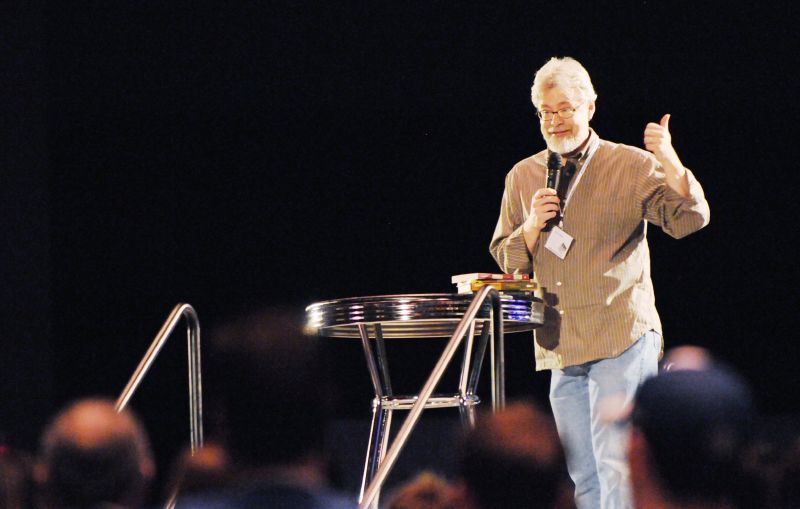
Byron Borger at Jubilee 2009

I spent the weekend at Jubilee, the annual student conference of the Coalition for Christian Outreach. Jubilee has a great reputation for emphasizing the theology of vocation – a reputation which was confirmed, by the way – but I didn’t expect the high level of fun generated by the conference. Saturday evening featured a hilarious (and moving) monologue from actress and writing Susan Isaacs (author of Angry Conversations with God) and a can’t-possibly-be-true-except-he-brought-pictures talk from Bob Goff, president of Restore International and good friend of Don Miller.

Photo: Byron Borger at last year’s Jubilee, but he looked basically the same this year. From livingjubilee via Flickr. Click for a larger image.

Occasionally, these streams of fun and vocation combined, such as the first night. In quick succession, seven speakers presented pecha kucha, a speed-presentation format of 20 slides, changing automatically every 20 seconds, whether the speaker is ready or not. The pecha kucha presenters included:

  • David Greusel, an architect speaking on the connection between architecture and faith, especially what he called “the lie” that “secular work” doesn’t matter in God’s kingdom on earth (Greusel was the lead designer of Pittsburgh’s PNC Park).
  • Gideon Strauss, President of the Center for Public Justice, who testified to the application of Isaiah 58 in our current society.
  • Leroy Barber, president of Mission Year, speaking about Green My Hood, a program which identifies the abuse of the environment in poor urban neighborhoods and looks for ways to bring good creation stewardship into the inner city.
  • Good friend of ESN Byron Borger of Hearts & Minds Books, who said that “part of this conference is learning to read deeply,” and reminded us that the word “disciple” means “student.”

As Benson Hines (who was also there) said on Twitter,

Lord, let me be as passionate about my calling as Byron Borger is about his.

More about Jubilee and some upcoming articles after the jump Continue reading

New World Religions Class Starting

Wat Arun, BangkokI’ll be starting one of my favorite teaching series next month: World Religions.  Here are the details.

Where: Lakeside Christian Church, Lakeside Park, KY (directions) Dates: March 3 through May 5 (no class March 24 or April 28) Time: 6:30pm to 8pm

We’ll be covering the history, beliefs, and practices of major world religions and new religious movements, including:

  • Christianity
  • Judaism
  • Islam
  • Hinduism
  • Buddhism
  • Mormonism
  • Wicca
  • Scientology

…with a few more thrown in just to be safe. The class will include time for discussion and coverage of the current state of each religion in the world and the U.S.

I hope you can make it!

Photo: Buddhist Temple in Bangkok, Thailand, by Stuck in Customs via Flickr

Swine Flu and Religious Persecution

Several media outlets are reporting that Egypt has ordered all pigs in the country to be slaughtered, out of concerns over swine flu. What does this have to do with religion? The Wall Street Journal has the best summary:

Egyptian human-rights activists have long complained of discrimination against Copts in education and in governmental hiring practices. The pork industry, a relatively small sector that caters to Christians and expatriates in Egypt, is one of the few businesses run exclusively by the Copts.

Pork is unclean in Islam, so the only pig farmers in Egypt are Christians. Sunday, the Christian farmers protested in the streets, and there is a danger of violence. Please be praying for the peace of Egypt, for reason to prevail (there is no evidence that humans can catch this flu directly from pigs), and for Christ to be lifted up.

Christians in College: Some Basic Resources

Here are a few starting points if you are interested in the place of Christians at colleges and universities. These books are excellent for either those with a concern for Christians at colleges and universities, or for Christian students who are starting to feel the tension between their faith in Christ and their life in the university.

Foundational Books

These books make the case for Christian involvement in higher education. They have each been influential to many Christian ministries, including my own, the Emerging Scholars Network.

A Christian Critique of the University by Charles Malik — Malik was a renowned Lebanese Christian diplomat, philosopher, and university professor, heavily influential in the early days of the United Nations. He delivered a series of lectures in 1981 at the University of Waterloo, which were collected in this book. Malik famously noted that the important question was not what the university thinks of Jesus Christ, but what does Jesus Christ think about the university? (Note: This book is out of print, but Malik’s equally influential lecture “The Two Tasks of the Christian Scholar” has been reprinted in a recent book of the same name, which features essays by a number of prominent Christian professors.)

The Outrageous Idea of Christian Scholarship by George Marsden – In the conclusion to his book, The Soul of the American University, Marsden called for Christians to create distinctively Christian scholarship. The ensuing uproar in the secular academia led Marsden to write this brief follow-up, which has become a challenge to a generation of Christians scholars.

The Scandal of the Evangelical Mind by Mark Noll – According to Noll, the “scandal of the evangelical mind” is that “there is not much of an evangelical mind.” A primary reason why evangelical Christians lack a presence in higher education is because many evangelical churches ignore the life of the mind and the importance of learning.

Books for Students

The next three books are excellent choices for either students heading to college or in their first year or two. Each of them will help students think about their Christian faith in the context of being a college student and, if they have ears to hear, will guide them in developing a well-grounded, well-educated faith.

How to Stay Christian in College by J. Budziszewski – Budziszewski is a professor of government and philosophy at the University of Texas at Austin, and this book is a short, practical guide based on questions that students have asked him over the years.

Welcome to College: A Christ-Follower’s Guide for the Journey by Jonathan Morrow – This book is a series of short essays on nearly everything conceivable subject that a Christian will deal with in college – philosophical questions, peer pressure, sex and dating, drinking – complete with discussion questions and suggestions for further reading. Perhaps most helpful, Morrow has put together a devotional guide for a student’s first year in college.

Outrageous Idea of Academic Faithfulness, The: A Guide for Students by Donald Opitz and Derek Melleby – Taking its lead from Marsden, Opitz and Melleby challenge students to take both their faith and their studies seriously. They describe the invaluable opportunity Christians have while in college to study and exercise their mind, to distinguish themselves from the world of “bread and circuses” that dominates so much of college life. This book counsels students to truly study “as unto the Lord.”

Next Steps

This final selection of books will help students (and others) bridge the gap between their faith and the rest of their life: their vocation, their career, their family life, the day-to-day routine of living. These books are excellent choices for juniors, seniors, recent graduates, or anyone seeking to love God with their heart, soul, mind, and strength.

The Call: Finding and Fulfilling the Central Purpose of Your Life by Os Guinness – Perhaps few of us feel like we have a “call from God,” yet Guinness reminds us that all of us are called by God to love him and love our neighbor. How we live that out, is different for each of us. This deep and insightful book helps to understand our unique vocation in the light of God’s call.

The Fabric of Faithfulness: Weaving Together Belief And Behavior by Steven Garber – Garber has put together has excellent guide to living a life consistent with your faith. I read this book the year after I graduated college, and it radically changed by understanding of Christianity by showing me that consistent Christianity requires a community of people living out their faith together. I’ve recommended this book frequently over their years.

Habits of the Mind: Intellectual Life As a Christian Calling by James Sire – Jim Sire is the retired editor-in-chief of InterVarsity Press, and he brought to that role a strong sense of the intellectual life. This book, one of the more popular ones I have offered to ESN members, describes a variety of intellectual virtues and how they fit into a life of Christian discipleship.

Prayer for Indian Christians

Amidst the presidential elections and economic turmoil in the U.S., American media has largely ignored the violence against Christians in India. 52 Christians in Orissa have been killed by Hindu extremists, as scapegoats for the murder of a Hindu leader by a Maoist group. Edward T. Oakes, S.J. puts the violence in perspective at the First Things website, noting that many converts to Christianity in India come from the “untouchable” castes and that their conversion is seen by some Hindus as a threat to Hindu identity and religion in India.

Please join me in prayer for our Indian brothers and sisters in Christ.