Two Emerging Scholars Network Updates

  1. I recently traveled to Berea College and the Ohio State University to speak about the Emerging Scholars Network. Read all about my visits here, and check out this blog post to see why these two very different schools are both important to ESN’s mission.

  2. My article Faith and Faculty has been published on the InterVarsity home page. In it, I share my own story of meeting Christ at college and explain why we need more Christian faculty at secular universities.

How Did You Celebrate Easter?

Easter Eggs

Easter Eggs

Do you think of worship, hospitality, or celebration as spiritual disciplines? If you’re like me, you associate the idea of “discipline” with things that are hard, like fasting, daily prayer, intense Bible study, and so on. But if a discipline is something that trains us to live and think rightly, then what better response to the resurrection can there be than over-the-top celebration?

In fact, celebration holds a place of honor in both of my top two books on spiritual disciplines. Richard Foster, in Celebration of Discipline, places celebration at the conclusion of his classic work, while Adele Ahlberg Calhoun puts Celebration at the very front of her Spiritual Disciplines Handbook.

Here’s what Calhoun writes about Celebration:

The world is filled with reasons to be downcast. But deeper than sorrow thrums the unbroken pulse of God’s joy, a joy that will yet have its eternal day. To set our hearts on this joy reminds us that we can choose how we respond to any particular moment. We can search for God in all circumstances, or not. We can seek the pulse of hope and celebration because it is God’s reality. Heaven is celebrating. Right now the cherubim, seraphim, angels, archangels, prophets, apostles, martyrs and all the company of saints overflow with joy in the presence of their Creator. Every small experience of Jesus with us is a taste of the joy that is to come. We are not alone — and that in itself is reason to celebrate. (Spiritual Disciplines Handbook, 27)

The Hickerson Family at Easter

The Hickerson Family, all dolled-up for Easter

Here are a few ways that my family and I celebrated the resurrection of Jesus:

  • Dressing up in new clothes (including new shoes for me)
  • Attending a packed church, taking communion, and hearing a powerful message on the hope of the resurrection
  • Singing “Christ the Lord is Risen Today” and the “Hallelujah Chorus” (and hearing perfect silence at that moment of tension before the final “Hallelujah”)
  • Joining extended family and old friends for an Easter feast of lamb, ham, and too much sugar, all while being welcoming my principal role models of hospitality, my father- and mother-in-law
  • Catching up – unexpectedly – with some good friends who have had a rough spring
  • Puzzling over my 6-year-old’s sudden obsession over reading the Bible – and trying to decide whether it is sincere or not (and whether that matters)
  • Delving into the study of God through conversation about justification and covenant
  • For my wife, playing (and winning) some great board games with cousins and friends we don’t see nearly often enough

All in all, a great day of celebration. And I didn’t even mention the eggs.

How did you celebrate Easter?

Facebook Google Reader Twitter Delicious LinkedIn Google Bookmarks Evernote WordPress Share/Bookmark

Related posts (automatically generated):

  1. Tom Sine asks about Easter HT to Christine Sine who posted Tom Sine is Blogging (April…
  2. Holy Week looking toward Easter The next day the great crowd that had come for…
  3. Greeting: Christ is Risen! Response:  Truly, He is Risen! First, as we read the…
  4. Why Does the Resurrection Matter? Yesterday, most Christians around the world celebrated the resurrection of…
  5. The Day in Between In between Good Friday and Easter, I’m taking time to…

Related posts brought to you by Yet Another Related Posts Plugin.

Emerging Scholars at Jubilee 2010

Cross-posted from the Emerging Scholars Blog

Byron Borger

Byron Borger at Jubilee 2009

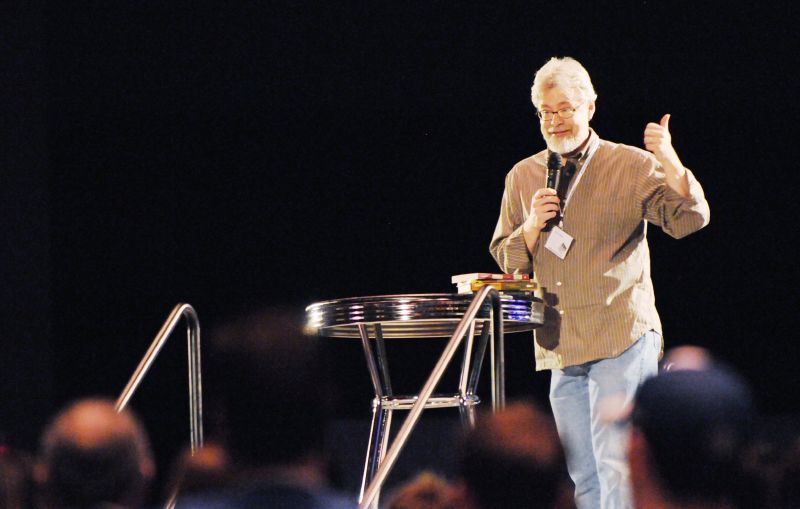
I spent the weekend at Jubilee, the annual student conference of the Coalition for Christian Outreach. Jubilee has a great reputation for emphasizing the theology of vocation – a reputation which was confirmed, by the way – but I didn’t expect the high level of fun generated by the conference. Saturday evening featured a hilarious (and moving) monologue from actress and writing Susan Isaacs (author of Angry Conversations with God) and a can’t-possibly-be-true-except-he-brought-pictures talk from Bob Goff, president of Restore International and good friend of Don Miller.

Photo: Byron Borger at last year’s Jubilee, but he looked basically the same this year. From livingjubilee via Flickr. Click for a larger image.

Occasionally, these streams of fun and vocation combined, such as the first night. In quick succession, seven speakers presented pecha kucha, a speed-presentation format of 20 slides, changing automatically every 20 seconds, whether the speaker is ready or not. The pecha kucha presenters included:

  • David Greusel, an architect speaking on the connection between architecture and faith, especially what he called “the lie” that “secular work” doesn’t matter in God’s kingdom on earth (Greusel was the lead designer of Pittsburgh’s PNC Park).
  • Gideon Strauss, President of the Center for Public Justice, who testified to the application of Isaiah 58 in our current society.
  • Leroy Barber, president of Mission Year, speaking about Green My Hood, a program which identifies the abuse of the environment in poor urban neighborhoods and looks for ways to bring good creation stewardship into the inner city.
  • Good friend of ESN Byron Borger of Hearts & Minds Books, who said that “part of this conference is learning to read deeply,” and reminded us that the word “disciple” means “student.”

As Benson Hines (who was also there) said on Twitter,

Lord, let me be as passionate about my calling as Byron Borger is about his.

More about Jubilee and some upcoming articles after the jump Continue reading

ESN Makes the News!

The good work of my InterVarsity colleague (and fellow ESN blogger) Tom Grosh has been recognized by his local paper. Tom is hosting an Emerging Scholars Network event later this month, “The Sociology of Faith,” featuring Christian college professor Donald Kraybill of Elizabethtown College. Kraybill will draw upon his academic expertise as a scholar of Amish culture, as well as his personal experiences, in discussing the impact of Christian faith on one’s work and study.

“Each academic discipline raises different questions for (Christians who are involved in those disciplines),” he explained. “I’ll be talking about some of the issues I’ve struggled with as a Christian and as a sociologist (and about) the ways that I, as a Christian, can teach sociology.” He added that he will focus on ways that individuals can work through issues such as the ones he experienced.

Pray for Tom as he finishes organizing this event. Pray, too, for the students, faculty, and church members who will attend the event and for Donald Kraybill as he prepares his talk.

Also, read Tom’s latest post on the ESN blog, What are you picking up for Lent? We’re used to the idea of giving up something to grow closer to God, whether for Lent or some other reason, but what about adding something to our lives?

Christian Privilege in the Academy?

Interfaith BannerIn InterVarsity and many other Christian organizations, we’re used to thinking of Christians as a minority – even a persecuted minority – within the academy, particularly at the more prestigious universities. For example, responding to a common question asked by many faculty and graduate students, we recently published an essay by Ken Elzinga of the University of Virginia titled “Being Open About My Faith Without Turning People Off.” There is another way of looking at Christianity in the university, however.

Photo credit: Interfaith chaplaincy banner at Nichols College, by Svadilfari via Flickr. Click for larger image.

Last week, my friend Julie forwarded me a link to Tricia Seifert’s article, “Understanding Christian Privilege: Managing the Tensions of Spiritual Plurality” (PDF). Comparing “Christian privilege” to the more commonly used terms male privilege and white privilege, Seifert identifies several areas of university life in which structure or assumptions favor Christianity over other religions, such as:

  • the academic calendar, which includes breaks for Christmas and sometimes Easter, but not High Holy Days, Ramadan, or other religious festivals
  • meal plans, which often don’t take into account the dietary needs of non-Christian students
  • at private colleges, chapel space, which, even if open to non-Christian use, is usually filled with Christian imagery (see this story about the recent creation of a Pagan worship space at the Air Force Academy)
  • nondenominational, but Christian “flavored,” prayer at graduation ceremonies and athletic events

Seifert offers some practical advice for addressing Christian privilege, and also suggests that Christian privilege affects the learning community:

The responsibility of educating the whole student includes creating a community in which all students feel safe to practice and share their spiritual beliefs and supported in learning about the spiritual beliefs of others. To create such a community, educators need to help students develop the ability and willingness to question educational practices and programs that privilege the spiritual identity development of one group over others. Students have made great strides in questioning other forms of privilege, such as male privilege and white privilege. The changing demographics of our college and university campuses and their increasing spiritual plurality necessitate a commitment to helping the campus community recognize and confront Christian privilege in the same way that it has confronted other forms of privilege.

Take a few minutes to read Seifert’s article (it’s about 6 pages) and consider what you think about the idea of Christian privilege.

Some questions for discussion:

How would you respond to Seifert’s article?

Do you agree that there is Christian privilege within the academy? Why or why not?

How do you think religious plurality affects the campus learning community?

How can Christians best contribute to the religiously diverse community at secular universities?

Did you watch the Super Bowl? (Updated)

And if so, with whom did you watch it?

My family and I joined the rest of our Adult Bible Fellowship for our annual Souper Bowl Party. This has become a central tradition among our group of church friends: a Super Bowl watching party combined with a soup & chili cook-off. We have a few families in our group with houses large enough to host everyone comfortably, along with finished basements where the many, many kids can gather. We’re still waiting for Cincinnati’s turn, but our group includes a couple of Purdue grads who were very happy with this year’s outcome. At least it wasn’t the Steelers. :)

The Super Bowl is a powerful cultural liturgy in the United States, part of the “military-entertainment complex” that James K. A. Smith describes in Desiring the Kingdom. Here, he explicates the National Anthem ritual:

The sounds of the anthem are usually accompanied by big, dramatic sights of the flag: a star-spangled banner the size of a football field is unfurled across the field by a small army of young people…And almost always, the concluding crescendo of the anthem — announcing that this is the “land of the free” and the “home of the brave” — is accompanied by a flyover frm military aircraft… (105-106)

A dead-on description of Carrie Underwood’s performance, no?

Meanwhile, in his Christianity Today cover story “Sports Fanatics,” Shirl James Hoffman questions whether our obsession with sports isn’t something diabolical:

On one level, Christians’ attraction to sports is easily understood. Sports are fun and exciting; when played well and in healthy contexts, they can be constructive leisure pursuits that enrich our lives. But organized sports, played at almost every level, too often bring out the worst in us. With astonishing frequency the reputation of higher education is sullied by players’, coaches’, and alumni’s crimes and indiscretions. Recruiting scandals, under-the-table payoffs, and academic cheating—all perpetrated in the name of athletic excellence—have become such regular features on the sports pages that we have come to accept them as the cost of a Saturday afternoon’s entertainment.

It’s worth reading the whole article, as well as Scot McKnight’s brief response. Hoffman’s new book, Good Game: Christianity and the Culture of Sports, delves into this issue in more depth.

Still, there are some good things that came out of the Super Bowl. Our church class has used it over the years to create a community-forming tradition, adapting the NFL’s big game into our own “cultural liturgy.” Last night, amid all of the ads objectifying women and belittling men, there was the small island of normality formed by Pam and Tim Tebow’s ad for Focus on the Family:

The ad was controversial, mainly because Focus on the Family is controversial. NOW strongly criticized the ad before it ran, but Andy Crouch asked an interesting question (via Twitter):

Was there any Super Bowl ad other than Focus’s that featured a realistic, admirable woman in a central role?

Did you watch the Super Bowl? What did you think of the ads, the hype, the combination with Christianity?

(BTW, lots of people asked, rhetorically, what NOW thought of all of the ads featuring objectified women. Well, you don’t need to ask rhetorically, because you can watch an awesomely titled video from NOW, Jockocracy Sexism Watch with Gloria Steinem, to get the straight scoop. I haven’t watched myself, so I can’t vouch for it except for the ridiculously awesome title.)

Update: I almost forgot another relevant resource.  Blog commenter Mike Austin edited Football and Philosophy: Going Deep, a collection of essays exploring, well, football and philosophy. Mike also publishes the Philosophy of Sports blog. His post last Friday: Religion and Football.

Facebook Google Reader Twitter Delicious LinkedIn Google Bookmarks Evernote WordPress Share/Bookmark

Related posts (automatically generated):

  1. ESN Book Club: Your Mind Matters (Updated) Update: To give you more time to order and start…
  2. Week in Review (Updated) [Editor's note: This is a new weekly feature from your...
  3. Richard John Neuhaus, 1936-2009 (Updated) Few Christians – few Americans, for that matter – have…
  4. Announcing a Few Changes Around Here (Updated) When Tom Grosh and I launched the Emerging Scholars Blog…
  5. Twitter: a tool for a new generation of academic conversation or Not? (Updated) You might remember various Technology in Higher Education posts exploring:…

Related posts brought to you by Yet Another Related Posts Plugin.

Best Books for Graduate Students?

A while back, I asked for your recommendations for the best books for undergrads, and you came through with a pretty impressive list. Let’s advance a few years.

What books do you recommend to graduate students, on God, on academia, or just about life in general?

There will probably be some overlap, but here are some common graduate school situations that might affect the list:

  • Deeper exploration of a specific discipline or profession
  • New life experiences (e.g. marriage, children, death of family and friends)
  • Coping with failure and success
  • The “quarterlife crisis
  • Growth and change in one’s spiritual life

What are your suggestions?

Facebook Google Reader Twitter Delicious LinkedIn Google Bookmarks Evernote WordPress Share/Bookmark

Related posts (automatically generated):

  1. Harvey Fellows: $16,000 for Graduate School This is a great opportunity for Christians pursuing graduate education….
  2. Best Books for Undergrads: Your Picks Thanks to everyone who weighed in on my request for…
  3. Best Books for Undergrads? In a mere 12 days(!), Tom and I will arrive…
  4. Seeking tips for international students On Friday, I led an International Discussion Forum on Randy’s Last Lecture at…
  5. Favorite Books of 2008 I enjoyed skimming Mr. Wilson’s Bookshelf: Favorite Books of 2008….

Related posts brought to you by Yet Another Related Posts Plugin.

Are Christian Professors Politically Conservative?

American Flag

American Flag at William Jewell College

On Friday, our week in review linked to Patricia Cohen’s article about political liberalism in the academy, “Professor is a Label That Leans to the Left.” The article was based on the work of sociologists Neil Gross (U. British Colombia) and Ethan Fosse (a PhD candidate at Harvard, where Gross worked until recently), who propose that academic liberalism is due to typecasting, similar to how nursing is considered a “woman’s job” by most Americans.

The academic profession “has acquired such a strong reputation for liberalism and secularism that over the last 35 years few politically or religiously conservative students, but many liberal and secular ones, have formed the aspiration to become professors,” they write in the paper, “Why Are Professors Liberal?” (PDF) That is especially true of their own field, sociology, which has become associated with “the study of race, class and gender inequality — a set of concerns especially important to liberals.”

Photo Credit: bbaltimore via Flickr

Gross, along with Solon Simmons of George Mason, has written a number of articles that have been quite valuable to my personal understanding of the academy, “The Social and Political Views of Professors” and “How Religious Are America’s College and University Professors?” Both papers are worth reading. I’ve distilled some of the more interesting numbers from the 2nd paper, along with some other sources, for a description of the climate for Christians on campus that I often share with churches.

The excellent website GetReligion.org, which focuses on the mainstream media’s converage of religion, asked if there were any “religious ghosts” in the article — that’s “GR-speak” for religious angles to a story that a journalist overlooked or ignored. Specifically, what role does religion play in the politics of university professors? Steve Rabey of GetReligion.org writes,

I wish Cohen had devoted more space to discussing the religious elements of academia’s liberal tilt. Unfortunately, she only briefly mentions “secularism” and academia’s preference for professors who embrace “a non-conservative religious theology.”

Personally, I think there is a religious component to the political liberalism of the academy, but it’s a complex relationship. Here’s what I wrote in my comment on GetReligion.org:

There’s really a need for two distinct articles, if not more. There’s the issue of conservative politics and the academy, and then there’s the issue of “conservative” religion and the academy. Many “conservative Christians” that I know in the academy, who hold to “conservative” views of Scripture, salvation, historicity of Jesus, etc., have overall political views that would be considered liberal by most Americans. In our culture at large, conservative religion and conservative politics are closely intertwined, but I think they are much further apart within the academy. (The most politically diverse group I know is the community of evangelical campus ministers, grad students, and faculty that I work alongside.) I’d love to see this distinction between religion and politics within the secular academy explored a bit more.

But enough of my thoughts. What do you think?

  • In the university, what’s the relationship between conservative politics and evangelical Christianity?
  • Are professors politically liberal because they are theologically liberal, vice versa, or doe one have nothing to do with the other?
  • How does the close association between evangelical Christianity and conservative politics in American culture affect the perception of Christianity within the academy?

Facebook Google Reader Twitter Delicious LinkedIn Google Bookmarks Evernote WordPress Share/Bookmark

Related posts (automatically generated):

  1. Political Expression on Campus, Take 2 Today, the Chronicle reports ($) on a new book, Closed…
  2. Political Expression on Campus Is there an election this year or something? Obviously, politics…
  3. “Creepy Treehouse”? Friending Your Professors or Students The Chronicle of Higher Education reports on a new online…
  4. Christian Privilege in the Academy? In InterVarsity and many other Christian organizations, we’re used to…
  5. The Outrageous Idea of Christian Scholarship: Discussion 1 George Marsden, Notre Dame’s Francis A. McAnaney Professor of History…

Related posts brought to you by Yet Another Related Posts Plugin.

Greatness in the Kingdom of God

In my work with the Emerging Scholars Network and Faculty Ministry, we call Christian students and faculty to be “redemptive influences within higher education.”  People often ask me what that means, and it’s tempting to paint a picture of thousands of C.S. Lewises, spiritual giants at every college in the country.  First of all, that would be unrealistic – someone like C.S. Lewis comes along once in a century.  But more importantly, it would give a distorted image of what a faithful follower of Christ in the academy looks like.  C.S. Lewis is famous because of his many acclaimed books, now being made into blockbuster movies, and his justified fame as both an apologist and scholar. However, as Lewis himself pointed out in The Great Divorce, greatness in heaven is very different than greatness in the world.  Worldly success, such as that enjoyed by Lewis, is not a guaranteed result of faithfulness to Christ.  The very opposite may be the case. Continue reading